Designing a postcard that looks great is one thing.
Designing a postcard that will move efficiently through the U.S. Postal Service is another.
Before you print hundreds—or thousands—of postcards, it’s worth making sure the size, orientation,address area and basic construction of the piece work with the mailing method you plan to use.
At SIG-1, we’d much rather identify a postal problem before the job is printed.
This surprises a lot of people.
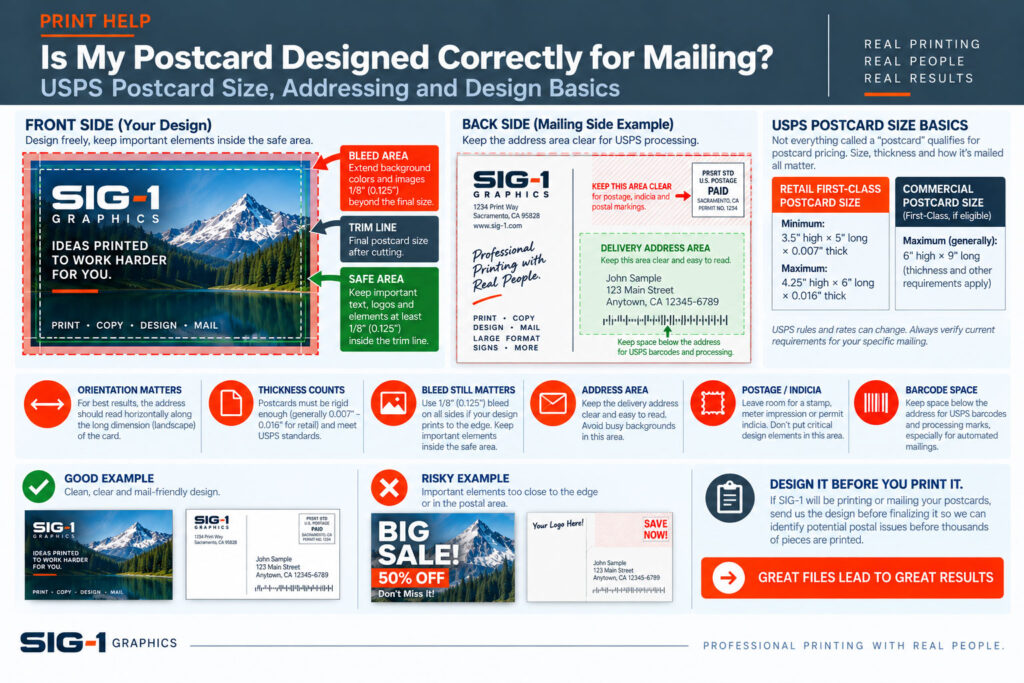
A single rectangular piece of cardstock may look like a postcard, but USPS pricing and processing categoriesdepend on its physical characteristics and how it is being mailed.
For a retail First-Class Mail piece to qualify for postcard pricing, it generally must be:
At least: 3.5″ high × 5″ long × .007″ thick
No larger than: 4.25″ high × 6″ long × .016″ thick
Commercial mailing standards can allow larger postcard-size pieces under certain circumstances, butdifferent preparation and eligibility requirements apply.
That’s why it’s a good idea to determine how the piece will be mailed before deciding exactly how it willbe designed and printed.
For postcard and letter-size mail, USPS determines the length of the piece relative to the direction in whichthe delivery address is read.
In plain English:
A normal landscape postcard should generally have the delivery address reading horizontally along thelong dimension of the card.
Turning the address or designing the mail panel in an unusual orientation can affect how USPS equipment processes the piece.
If you’re doing something unconventional, let us look at it before printing.
The mailing side of your postcard isn’t just another blank canvas.
USPS processing equipment needs to read the delivery address and may apply barcodes and other markings to the piece.
Keep the delivery address easy to find and easy to read.
Avoid placing busy photographs, patterns or other competing information directly behind the address.
A clean mailing area makes life easier for both postal equipment and the person receiving the piece.
Your postcard will need postage.
Depending on how the mailing is being prepared, that may be a stamp, meter impression, permit imprint or another approved postal marking.
Don’t design critical information into the area where the postage or indicia needs to appear.
If SIG-1 will be handling the mailing, talk to us before finalizing that portion of the design so we can tell you what needs to be reserved.
Automated mail processing can involve USPS barcodes applied to the mailpiece.
That means the address side should be designed with postal processing in mind—not filled edge-to-edge with important text and graphics.
If we’re preparing your mailing, we can help make sure the layout provides appropriate space for addressing and postal processing.
USPS also considers characteristics such as:
A piece can be physically mailable without necessarily qualifying for the lowest postage rate or a particular automation category.
That’s an important distinction.
Postal requirements don’t replace normal printing requirements.
If your background color, photograph or graphic is intended to print all the way to the edge, it still needs bleed.
SIG-1 generally recommends 1/8″ (.125″) bleed on all sides unless we specify otherwise.
And just like any other printed piece, important information should remain safely inside the trim.
It’s easy to spend all your time designing the beautiful promotional side of a postcard and treat the mailing side as an afterthought.
Don’t.
The mailing side can still carry branding, a call to action and other marketing information.
It simply needs to share the space with the functional elements required to get your postcard delivered.
A good postcard design considers both sides from the beginning.
If your postcards are being prepared as an automated commercial mailing, additional USPS standards may apply beyond simply meeting the basic physical dimensions of a postcard.
Those requirements can affect addressing, barcoding, dimensions, thickness and the overall design of the mailpiece.
This is one reason we don’t recommend designing a large mailing entirely around assumptions about postage.
Determine the mailing method first. Then finalize the design.
Let us look at one.
Seriously.
If SIG-1 will be printing or mailing your postcards, send us the design before you consider it completely finished.
We’ll look at the piece from both sides:
Does it work as a printed piece?
and
Does it work as a mailpiece?
Catching a bleed problem before printing is easy.
Catching a postal-design problem after 5,000 postcards have already been printed is considerably less fun.
SIG-1 Graphics
Professional printing with real people looking at your files.
Sacramento, California

Combining old world artisan craftsmanship with cutting edge technology, Sig-1 exerts a visual mastery over every printed document and image it produces. Sig-1’s failsafe printing methods offer meticulous attention to detail, high touch personal service, served with a creative and quirky style that turns every print job into a delightful experience.

