You’ve designed the piece, sent us the file and received a proof.
You’re almost there.
But before you click “Approved”, take a few minutes and look carefully at the entire project.
A proof is your opportunity to catch problems before your job goes into production.
Five minutes now can prevent a much more expensive problem later.
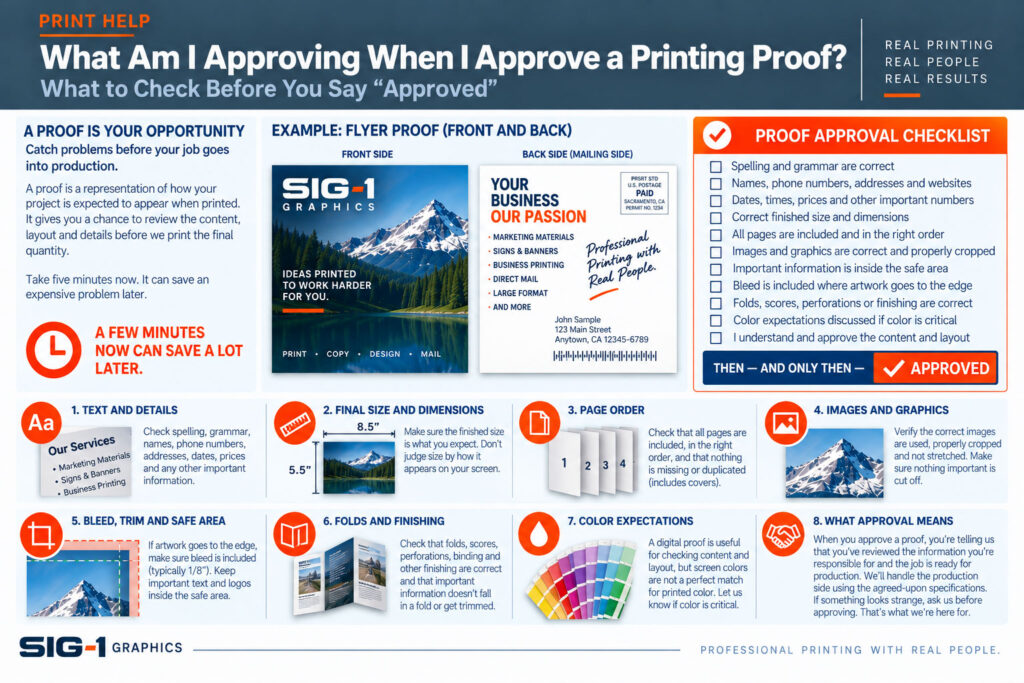
A proof is a representation of how your project is expected to appear when produced.
Depending on the project, SIG-1 may provide a digital PDF proof, a physical proof or another type ofproduction proof.
The purpose is simple:
Make sure we’re producing what you intended.
When you approve a proof, you’re telling us that you’ve reviewed the content and layout and that the job is ready to move forward.
This is probably the most important part of proofing.
When you’ve been working on a design for hours, your brain has a remarkable ability to see what you expect to see instead of what’s actually there.
Read everything.
Check:
Pay particular attention to information that’s easy to overlook but expensive to correct after printing.
Make sure the dimensions of the finished piece are what you expect.
An 8.5″ × 11″ flyer and an 8″ × 10″ flyer may look nearly identical on a computer screen—but they’re not thesame printed product.
If the piece folds, binds, inserts into an envelope or fits into another product, finished size becomes evenmore important.
Don’t judge physical dimensions by how large the proof appears on your monitor.
Check the dimensions listed with the proof or confirm them with SIG-1.
For multi-page documents, don’t just inspect the first few pages.
Check:
For booklets, remember that covers are pages too.
If something appears to be missing, duplicated or out of sequence, tell us before approving the proof.
Look carefully at every photograph, logo and graphic.
Ask yourself:
A proof may also reveal potential image-resolution issues.
If we see something that concerns us, we’ll do our best to bring it to your attention.
If backgrounds, photographs or graphics are supposed to extend to the edge of the finished piece, make sure they extend properly into the bleed.
Important text and logos should remain safely inside the trim.
Remember our simple rule:
Backgrounds go OUT.
Important information stays IN.
If you’re unsure what you’re looking at, ask us.
If your project will be folded, scored, perforated, die-cut, bound or otherwise finished, pay attention to how the design relates to those features.
For example:
Finishing is part of the design—not something that happens independently afterward.
This one deserves special attention.
A PDF proof viewed on a monitor is useful for checking content, placement and general appearance, butyour monitor is not the printing press.
Screens display color using RGB light. Printing uses inks or toner, generally based on CMYK.
Monitor brightness, calibration and viewing conditions also vary.
Because of this, a digital proof should not automatically be treated as an exact prediction of printed color.
If a particular color is critical to your project, tell SIG-1 before approving the job.
Depending on the project, we may recommend a physical proof or discuss other color-management options with you.
When you approve a proof, SIG-1 understands that you’ve reviewed the information you’re responsible for supplying and that the job is ready for production.
That includes things such as:
SIG-1 will continue to handle the production side of the job using the specifications we’ve agreed upon.
And yes—we’re real people looking at your files.
If we notice something that appears obviously wrong, we’re going to say something.
But the customer remains the person who knows whether John’s phone number is correct, Tuesday really should say Thursday, or the sale price should be $29.95 instead of $299.50.
That’s why your final review matters.
If something on the proof looks strange, ask us about it.
If the size doesn’t make sense, ask.
If you’re wondering why there are crop marks, ask.
If a color concerns you, ask.
If you’re not sure whether something will be trimmed off, ask.
There is absolutely nothing wrong with asking a question before approving a proof.
That’s what the proofing process is for.
Before approving, make one last pass:
□ Spelling and grammar
□ Names, phone numbers, addresses and websites
□ Dates, times, prices and other important numbers
□ Correct finished size and dimensions
□ Correct images and cropping
□ Correct page count and page order
□ Important information safely inside the trim
□ Bleed where artwork reaches the edge
□ Folds, perforations or finishing positioned correctly
□ Color expectations discussed if color is critical
Then—and only then—
APPROVED.
SIG-1 Graphics
Professional printing with real people looking at your files.
Sacramento, California

Combining old world artisan craftsmanship with cutting edge technology, Sig-1 exerts a visual mastery over every printed document and image it produces. Sig-1’s failsafe printing methods offer meticulous attention to detail, high touch personal service, served with a creative and quirky style that turns every print job into a delightful experience.

