Choosing paper can be surprisingly confusing.
80 lb. text. 100 lb. text. 80 lb. cover. 100 lb. cover. Coated. Uncoated. Gloss. Matte.
What does all of that actually mean—and which one should you use?
The good news is that you don’t need to become a paper expert.
Tell SIG-1 what you’re printing, how you want it to feel and how it will be used, and we’ll help you choose anappropriate stock.
But understanding a few basics makes the conversation much easier.
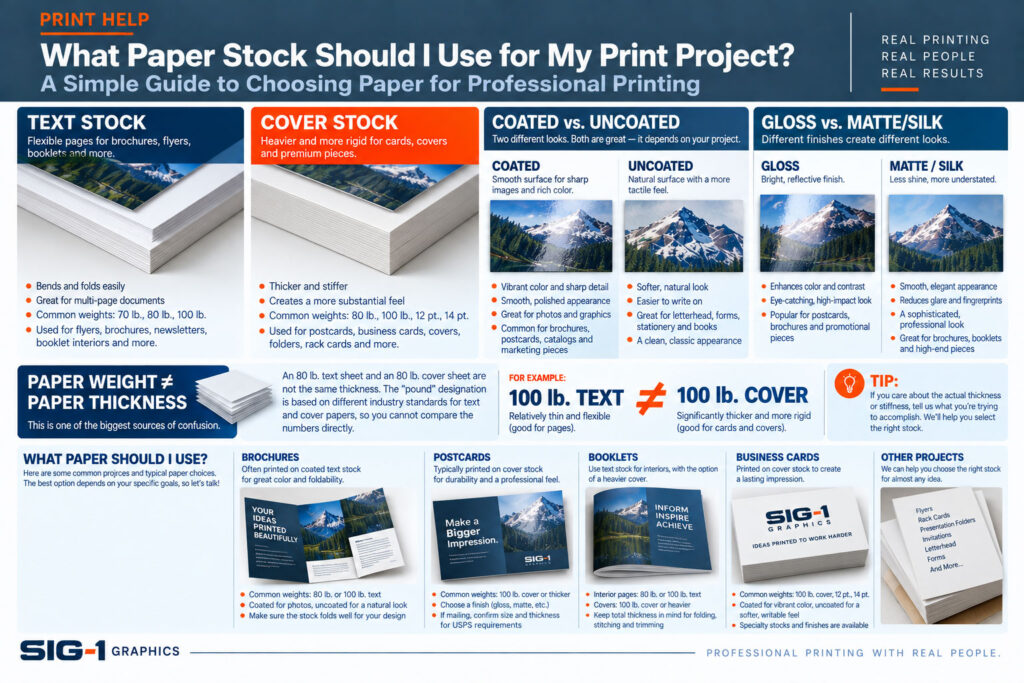
This is the easiest place to start.
Text stock is generally used for things such as:
It bends and folds relatively easily.
Cover stock is heavier and more rigid and is commonly used for:
InvitationsCards and other pieces that need more body
Think of it this way:
Text stock = pages.
Cover stock = cards and covers.
That’s not an absolute rule, but it’s a very useful starting point.
Here’s where paper terminology gets strange.
An 80 lb. text sheet and an 80 lb. cover sheet are not the same thickness.
In fact, cover stock is substantially heavier and more rigid.
The “pound” designation comes from traditional paper-industry basis weights, which use different parent-sheet sizes for different categories of paper.
That means you generally cannot compare the pound numbers directly between text and cover stocks.
For example:
100 lb. text is not the same paper as 100 lb. cover.
If you care about the actual thickness or stiffness of a sheet, tell us what you’re trying to accomplish ratherthan choosing solely from the pound number.
We’ll help you select the right stock.
Coated vs. Uncoated Paper
Another major decision is whether you want a coated or uncoated sheet.
Coated stocks have a smoother surface designed to hold ink or toner closer to the surface of the paper.
They are often a good choice when you want:
Sharp photographsRich color
Crisp graphicsA polished commercial appearance
Coated stocks are commonly used for brochures, postcards, marketing pieces, catalogs and high-qualitypromotional printing.
Uncoated stocks have a more natural paper surface.
They are often used for:
Uncoated paper can create a softer, more tactile appearance and is often easier to write on.
Neither is automatically better.
They simply create different results.
Coated papers are available in different finishes.
A glossier surface tends to emphasize photographs, contrast and color.
A matte, silk or satin surface generally has less shine and can provide a more understated appearancewhile still offering the benefits of a coated sheet.
Paper manufacturers don’t always use these terms in exactly the same way, so don’t get too hung up on thename.
If the finish matters to you, the best solution is simple:
Look at an actual paper sample.
Does Thicker Paper Mean Better Paper?
No.
It means thicker paper.
A luxury invitation might benefit from a substantial cover stock.
A folded brochure might work much better on a lighter sheet.
A booklet with very heavy interior pages can become bulky and difficult to fold.
A postcard needs enough body to survive handling and meet the requirements of the mailing methodbeing used.
The best stock is the one that fits the project.
Heavier isn’t automatically better.
For many brochures, a coated text stock is a good starting point.
It provides good reproduction for photographs and graphics while remaining flexible enough to fold.
The right weight depends on the size, fold style and feel you’re trying to achieve.
If the brochure needs to feel especially substantial, we can discuss heavier options.
What Paper Should I Use for a Postcard?
Postcards are normally produced on cover stock because they need more rigidity than a typical flyer.
But paper selection isn’t just about appearance.
If the piece will be mailed, its size, thickness and construction may affect USPS processing and postage eligibility.
If SIG-1 will be mailing the postcard, let us know before the stock and finished size are finalized.
What Paper Should I Use for a Booklet?
Booklets often use one of two approaches.
A self-cover booklet uses the same paper for the cover and interior pages.
Another option uses a heavier cover stock with lighter interior text stock.
Which is better depends on page count, appearance, budget and how the booklet will be used.
Very heavy paper isn’t always ideal for saddle-stitched booklets because the combined thickness of the nested sheets affects folding, trimming and creep.
Business cards are generally printed on cover stock.
From there, the decision becomes one of feel and appearance.
Smooth or coated stocks can produce crisp graphics and strong color.
Uncoated stocks can provide a softer, more tactile feel and may be preferable when someone needs to writeon the card.
There are also specialty stocks and finishing options available when the project calls for something different.
This is an important question that is often forgotten.
If your piece includes:
tell us.
Some coated surfaces are less friendly to pens, pencils or certain markers than uncoated paper.
The way the printed piece will actually be used should influence the paper choice.
Color Can Look Different on Different Papers
Paper is part of the final printed image.
Bright white coated paper reflects light differently than a warmer uncoated stock.
Ink and toner also interact differently with different surfaces.
As a result, the same artwork can have a somewhat different appearance depending on the paper it’sprinted on.
If color or overall appearance is particularly important, ask us about paper samples or proofing options.
Paper has texture.
It has stiffness.
It has weight.
It reflects light.
It feels different in your hand.
Those characteristics are difficult to communicate through a website.
If paper choice is important to your project, stop by SIG-1 or ask us to show you some samples.
Sometimes holding two sheets next to each other answers the question immediately.
You don’t need to call us and say:
“I’d like 100 lb. #2 gloss cover with this particular finish.”
You can simply tell us:
“I want this postcard to feel substantial.”
“I want this brochure to look high-end but not shiny.”
“People need to be able to write on this.”
“I need to keep the mailing cost under control.”
“I want the photographs to look great.”
Those are useful instructions.
We’ll translate them into paper specifications.
SIG-1 Graphics
Professional printing with real people helping you choose the right paper.
Sacramento, California

Combining old world artisan craftsmanship with cutting edge technology, Sig-1 exerts a visual mastery over every printed document and image it produces. Sig-1’s failsafe printing methods offer meticulous attention to detail, high touch personal service, served with a creative and quirky style that turns every print job into a delightful experience.

