If you’ve requested printing quotes, you’ve probably heard the terms digital printing and offset printing.
So which one is better?
The answer is:
It depends on the job.
Digital and offset are two different production methods, each with its own strengths.
At SIG-1, we produce both digital and offset printing, which means we can choose the process that makes the most sense for your particular project rather than trying to force every job onto the same type of equipment.
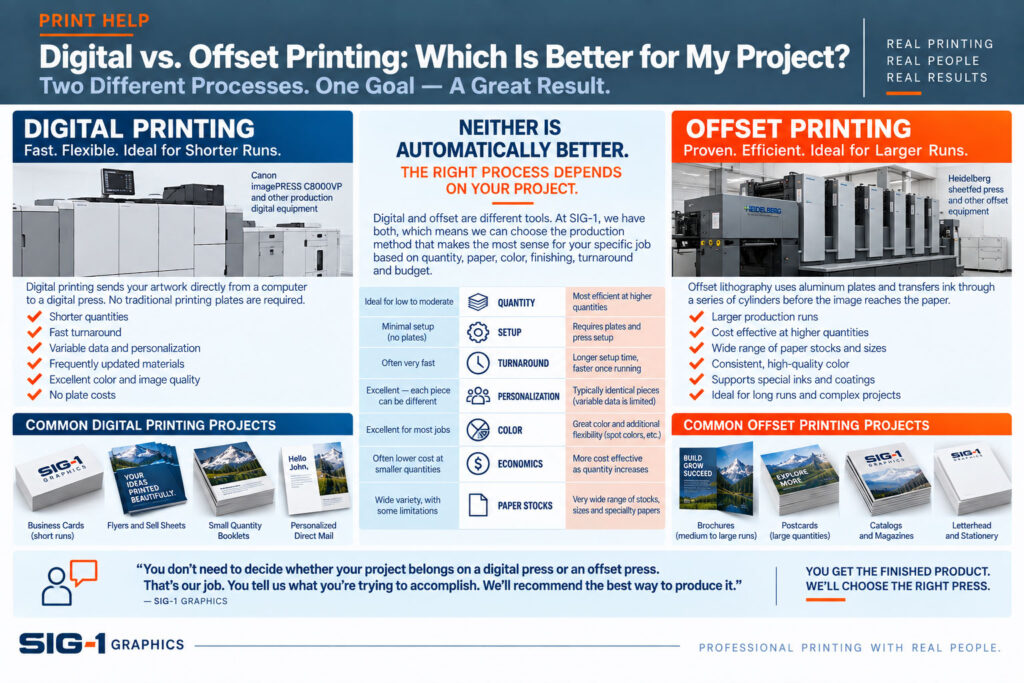
Digital printing sends the artwork directly from a computer to a digital printing press.
There are no traditional printing plates to manufacture.
That makes digital printing particularly well suited for:
Modern production digital presses are capable of excellent color and image quality.
For many everyday commercial printing projects, digital is an extremely effective production method.
Offset lithography uses printing plates and transfers ink through a series of cylinders before the imagereaches the paper.
It requires more setup before the first finished sheet comes off the press.
Once the press is running, however, offset printing can become extremely efficient for larger quantities.
Offset is particularly well suited for:
This is one of the biggest differences.
Digital printing has relatively little traditional press setup.
That makes it economical to produce smaller quantities.
Offset printing requires more preparation—including plates and press setup—so producing a very smallquantity may not make economic sense.
But as the quantity increases, the economics can change.
The setup cost is spread across more pieces, and offset can become the more efficient production method.
There isn’t one magic quantity where every job switches from digital to offset.
The crossover depends on the project.
Is Offset Printing Better Quality?
Not automatically.
This idea comes partly from an earlier generation of digital printing equipment.
Professional digital presses have improved enormously.
For many commercial printing projects, digital printing produces excellent results.
Offset still offers advantages for certain jobs, but “offset = professional and digital = inferior” simplyisn’t an accurate way to think about modern commercial printing.
The right question is:
Which process will produce the result this project needs?
No.
Digital is often economical at lower quantities because it avoids traditional plate and press setup.
But that doesn’t mean digital is always the least expensive method.
As quantities increase—or depending on the paper, finished size, color requirements and finishing—the economics may favor offset.
That’s why SIG-1 looks at the whole project before recommending a production method.
Digital printing can often be produced quickly because there are fewer traditional setup steps.
That can make it an excellent option when deadlines are tight.
Offset requires more production preparation, so scheduling needs can be different.
But turnaround depends on more than the press.
Paper availability, bindery, coatings, folding, cutting, mailing and other finishing operations can all affect the completion date.
If you have a deadline, tell us when you request the quote, not after the job is already in production.
Both processes can produce excellent color, but they don’t produce color in exactly the same way.
Digital presses typically reproduce process color through their own toner- or ink-based imaging systems.
Offset presses traditionally use printing inks and can provide additional flexibility for certain color requirements.
If your project involves:
tell us before production.
We’ll determine which process and proofing approach makes sense for the job.
This is an area where digital printing has a major advantage.
Digital production can allow individual printed pieces to contain different information.
For example:
Instead of printing 1,000 identical pieces, it may be possible to print 1,000 individually customized pieces.
That’s called variable data printing.
It’s particularly useful for direct mail and personalized marketing.
Both digital and offset presses can run a wide variety of papers, but every production device has its own size, thickness and substrate limitations.
Some papers may be better suited to one process than another.
This is another reason it’s useful to tell us what you want the finished piece to look and feel like, rather than specifying a production method yourself.
Usually, you don’t need to.
Tell us:
We’ll determine the appropriate way to produce it.
If there are meaningful choices between digital and offset, we’ll discuss them with you.
Suppose you need a brochure.
At 100 copies, digital production might make the most sense.
At 10,000 copies, offset may become more attractive.
The artwork hasn’t changed.
The finished product may look very similar.
What changed was the economics of producing it.
That’s why quantity is one of the first questions a commercial printer asks.
You don’t need to decide whether your project “belongs” on a digital press or an offset press.
That’s our job.
At SIG-1, we look at the quantity, paper, size, color, finishing, turnaround and economics of the project andchoose the production method that makes sense.
Sometimes that’s digital.
Sometimes it’s offset.
The goal isn’t to put your job on a particular machine.
The goal is to produce your job well.
SIG-1 Graphics
Professional printing with real people choosing the right process for your project.
Sacramento, California

Combining old world artisan craftsmanship with cutting edge technology, Sig-1 exerts a visual mastery over every printed document and image it produces. Sig-1’s failsafe printing methods offer meticulous attention to detail, high touch personal service, served with a creative and quirky style that turns every print job into a delightful experience.

